
Reviewed · CITY TOURS
Tour Old City/Discover Old Town
Old City/Discover Old Town turns Cidade Velha into a real timeline you can walk through, from fortress to cathedral ruins to a pillory tied to slavery. I like that the route is tight and practical, so you get meaningful stops without spending your whole day in a vehicle. I also like the human scale of a private group tour, where the guide can pace you through the details. One drawback to keep in mind: a small number of people have felt the tour time ran shorter than expected, so it’s smart to confirm timing when you book.
The heart of the experience is how these sites connect to the Portuguese era and the early commercial importance of the islands. You’ll also get a tour feel that can vary by vehicle and meeting point, since one group reported no clear welcome sign and a compact car layout. If you like your history straight, with specific places and dates, this works well. If you need a long, drawn-out itinerary, plan to ask questions early.
Key highlights you should care about
- Portuguese power made visible: fortress, cathedral ruins, and the Manueline-style Pelourinho column in the main square
- UNESCO Old Town focus: Cidade Velha’s historic center has UNESCO World Heritage status since June 2009
- Concrete names and dates: Drake’s 1585 attack, church work around 1495, the convent after 1640, and damage events in 1712 and 1754
- Mostly free entry stops: several key sites are free to enter, with only the fortress typically requiring a paid admission ticket
- Private transportation with flexible feel: pickup is offered, and you’ll tour with only your group
Cidade Velha: Why this Old Town walk matters on Santiago
Cidade Velha, on Santiago, is the kind of historic place that feels both close and complicated. This is where Ribeira Grande’s old city identity grew, and where Portuguese presence in the archipelago became visible through architecture, fortifications, and public spaces.
What I like about this tour format is that it sticks to a short list of high-impact sites. You’re not trying to “collect stamps” from ten locations that blur together. Instead, you see a chain of stories, from defense and church life to municipal power and punishment.
You’ll also appreciate the historical geography. This part of Santiago played a key role in trade routes in the wider Atlantic world, positioned between Africa, Europe, the Americas, and beyond. That context helps the ruins make sense, instead of feeling like leftover walls.
More City Tours in Santiago
- Praia & Cidade Velha: Guided City Tour
★ 4.8 · 80 reviews - Praia: Baobab Mysterious Tree, Green Valley & Old City Hike
★ 4.8 · 53 reviews - Private Tour Cidade Velha/Discover OLD CITY
★ 5.0 · 4 reviews
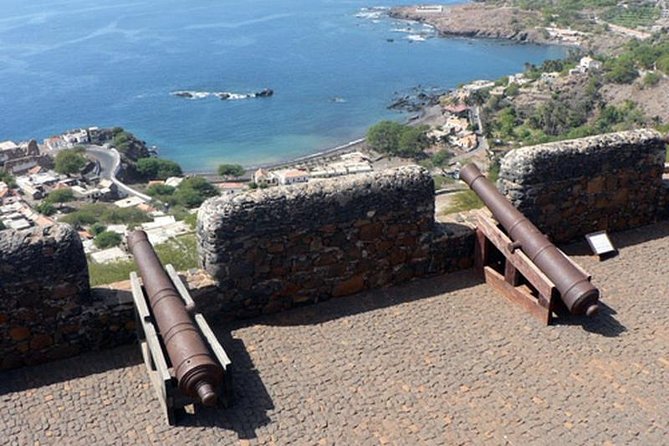
Fortaleza Real de San Felipe: Portuguese defense, built after an attack
The tour begins at Fortaleza Real de San Felipe, the Fortress of S. Filipe. The big reason to care is timing. This fortress ties into the Portuguese effort to secure control after Drake’s attack in 1585, with construction starting in the following years and the city garrisoned from the fort.
It’s also a reminder that “old town” history is not just soft and religious. Fortresses are about money, fear, and strategy. In the city, you may also see a pillory in the square, described as a vivid memory of the slavery era on the island, where enslaved people were publicly punished.
Practical note: admission ticket for this stop is not included. So if you budget tightly, you’ll want a little extra cash aside for the entry fee.
If you’re hoping for a big panoramic payoff, manage expectations. This is more about what the fort represents than about modern viewpoints. Still, the history hits hard when you stand where people once expected to defend the city.
Se Catedral in ruins: the Portuguese church that still tells a story
Next comes Se Catedral, today in ruins. The tour frames it as the first Portuguese church erected on the black continent, and what remains is kept to prevent key references from disappearing.
The value here is the contrast. You’re not visiting a fully restored monument. You’re seeing preservation in motion: the pieces that survive still communicate what the Portuguese set down, and what time took away.
You’ll also hear how commerce and shipping helped Ribeira Grande grow quickly into a commercial center, which is part of why a cathedral mattered. In other words, this is church history tied to shipping and supply, not just local spirituality.
Admission here is listed as free, so it’s an easy win on a budget. Bring a moment of quiet curiosity, because ruins reward patience more than speed.
Igreja Nossa Senhora do Rosário: one of Santiago’s oldest church sites
The Church of Our Lady of the Rosary is one of the older temples in Santiago and Cape Verde. It’s described as built around 1495, which is early enough that it changes how you picture the timeline of the island.
This stop also connects to preaching. Father António Vieira preached here in 1652, during a period linked to a route from Portugal to Brazil. The story adds a human layer: Vieira was surprised by the wisdom of local clergy and canons, enough to comment on it at the time.
For you, this is a good stop if you like historical figures, not just buildings. For a quick tour, it also works because the narrative is specific. You’re not guessing why a church is important. You’re learning what happened here.
Entry is free for this stop. Still, treat it respectfully. Even if the tour keeps moving, this is one of those places where you should slow down for a minute.
A few more Praia trips to weigh against this one
- Santiago: Landscapes, Street Art, and Markets Day Trip
★ 4.8 · 316 reviews - From Port of Praia: Island Tour for Cruise Ship passengers
★ 4.5 · 190 reviews - Serra Malagueta: Principal Valley Hike & Lunch with Locals
★ 4.7 · 64 reviews - Santiago: Calabaceira Valley Trek & Visit to Cidade Velha
★ 4.8 · 49 reviews
Pelourinho: the Manueline-style column that shows municipal power
Pelourinho is one of the most direct “what did the authorities do here?” stops in the itinerary. In Cidade Velha’s main square, you’ll see a Manueline-style white marble column set in the historic center.
This column is tied to municipal power and slavery-era punishment. The pillory is where rebel enslaved people were publicly punished, described as part of the brutal legal system.
The dates matter. It’s given as built in 1512 or 1520, and it was restored in the late 1960s. That range is a useful reminder: in older sites, history is sometimes precise and sometimes imperfect, and tours do their best to reflect what’s documented.
Entry is free here, and the stop length is short. That means you’ll want to pay attention to the guide’s explanation, because the meaning can be easy to miss if you’re only taking photos.
If your goal is to understand the “real” old town, this is the stop that anchors it. Just be aware of the subject matter and keep your tone thoughtful.
Convento de São Francisco: a mission site shaped by change and damage
The final historic stop is the Convento de Sao Francisco, constructed around 1640 on land donated by Joana Coelho, described as a wealthy landowner and widow of Captain Fabião de Andrade.
This stop helps explain how religious missions evolved on the island. The convent is said to have welcomed Franciscan religious who replaced the Jesuits in Cape Verde. It also served as a training center where priests taught community crafts, so it wasn’t only a church building. It had an educational role in daily life.
Then history hits again with destruction. The convent was practically destroyed after an attack by privateer Jacques Cassard in 1712 and also affected by a storm in 1754.
That mix of events is what makes this stop feel real. The island’s history wasn’t one long smooth chapter. It was changing power, conflict, and weather. You’re seeing that in the story of a single site.
Entry is free for this stop, and that’s a nice bonus for keeping value strong.
Timing, transport, and the stuff that can make or break the day
The advertised duration is 2 to 3 hours. That’s a good length for old town history because it forces focus. You’ll likely finish while you still have energy to explore on your own for lunch, a beach walk, or a slow wander through streets nearby.
That said, there’s one practical warning from real-world experience. One group expected a longer half-day rhythm and found the tour wrapped closer to 2.5 hours, then got asked about paying more to do additional things. I’d treat that as a clue to manage your expectations. If you want extra time beyond the listed stops, ask clearly at booking or ask your guide on the spot what’s possible within the time you have.
Transport is “private transportation,” and pickup is offered. Reviews also hint that vehicles can be compact, with a small sedan used for multiple people, meaning it can feel tight. If you’re sensitive about comfort or have mobility needs, mention that when you confirm pickup, even if your physical ability is fine.
Also, one group reported there was no welcome sign at meeting time, despite a promise. So if you’re meeting the guide at a pickup point, be ready to actively look for your driver by name or phone contact, not just a sign.
In short: this tour is a solid plan, but it runs on local timing and practical logistics, so a little flexibility keeps it smooth.
Price and value: what you’re really paying for
At $29.60 per person, this is priced like a budget-friendly way to get guided context for key sites in Cidade Velha. You’re not just walking around on your own. You’re paying for a guide with enough local history to connect names, dates, and sites in a way that makes the ruins and monuments easier to understand.
Included is private transportation. That matters on an island like Santiago, where getting to older parts of town and back can be time-consuming if you’re figuring it out alone.
What about extra costs? The main likely add-on is admission for Fortaleza Real de San Felipe, since it’s listed as not included. Most other stops in the route are listed as free, including Se Catedral, Igreja Nossa Senhora do Rosário, Pelourinho, and Convento de Sao Francisco. So your “all-in” cost should stay reasonable.
One more value point: the itinerary is designed around high-signal stops. When you’re paying for a guide, you want the guide time to go to places with clear stories. This route does that.
The guide experience: what good looks like here
The tour description talks about a driver with years of experience, and that shows up in the best versions of the experience: clear pacing, safe and comfortable transport, and practical help like lunch recommendations afterward.
A guide named Nelson has been specifically praised as warm, and as someone who kept the visit well-paced and interesting. Humor also came up, which is a real asset on history tours because it keeps the heavier topics from turning into a lecture.
If you want to get the most out of the tour, your part is simple: ask one or two questions about how the Portuguese built power here, and how that connects to the commercial role of the island. A strong guide will turn those questions into a story, not just a fact dump.
What to expect at each stop, in plain terms
You’ll move through Old Town in a way that feels like guided walking breaks, not a long marching line. Expect short time blocks at each place, then travel between them by vehicle.
Fortaleza Real de San Felipe gives you the defense and Portuguese presence angle, and it’s where you’ll most likely pay an admission ticket. Se Catedral focuses on ruins and preservation, with the religious and political context tied together. Igreja Nossa Senhora do Rosário adds human stories and older church origins. Pelourinho hits the municipal power and punishment history, which can be heavy, so bring a respectful mindset. Convento de Sao Francisco closes the loop with mission life, training, and the destruction timeline.
If you’re visiting as a pair or small group, private pacing is a plus. If you’re traveling with kids, the tour is short enough to keep attention, but the slavery-related topic at Pelourinho should be handled age-appropriately. You’ll know your group best.
Who this tour suits best
This works especially well if you like:
- Portuguese colonial-era sites on the ground, not just from photos
- History with names and dates, not vague “then and now” commentary
- A short, focused walk where you still have time for lunch and independent exploring afterward
It may be less ideal if you:
- Want a long, slow-paced, sit-down style tour
- Need a guaranteed schedule far longer than 2 to 3 hours
- Strongly prefer fully restored monuments, because several stops are explicitly in ruins
The tour also allows service animals, and it’s described as most travelers can participate. If you have any concerns, it’s smart to ask before you go, especially about uneven ground around older sites.
Should you book Old City/Discover Old Town?
I’d book this if you’re visiting Santiago and want a guided hit of Cidade Velha’s biggest stories without eating your whole day. The value is strong for the price, especially because several major stops are free and the route focuses on key monuments tied to Portuguese-era power and early island history.
Skip it only if you’re specifically looking for a longer, half-day that stretches far beyond 3 hours, or if the slavery-related content would be difficult for your group. In that case, you might still visit the area on your own later, but you’ll miss the connecting explanations that make these ruins and columns click.
If you do book, do two smart things: confirm the planned duration when you reserve, and plan on paying the admission ticket at Fortaleza Real de San Felipe. With that in mind, this tour can give you a fast, meaningful grasp of why Cidade Velha sits at the center of Cape Verde’s early story.
FAQ
How long is the Old City/Discover Old Town tour?
The tour runs about 2 to 3 hours.
What stops are included in the itinerary?
The route includes Fortaleza Real de San Felipe, Se Catedral, Igreja Nossa Senhora do Rosário, Pelourinho, and Convento de Sao Francisco.
Is pickup included?
Yes, pickup is offered, and the tour uses private transportation.
Are entrance fees included?
All fees and taxes are not included. The fortress stop lists admission as not included, while several other stops are listed as free.
How much does it cost?
The price is $29.60 per person.
Is the tour private?
Yes, it’s described as a private tour or activity, meaning only your group participates.
What is the booking lead time?
On average, it’s booked 16 days in advance.
What if the weather is poor?
The experience requires good weather. If it’s canceled due to poor weather, you’ll be offered a different date or a full refund.
What is the cancellation policy?
Free cancellation is available up to 24 hours before the experience start time for a full refund. If you cancel less than 24 hours before, the amount paid is not refunded.
Just added around Praia
- Cape Verde: Best Hikking Trails of Santiago Island – 6 Days★ 5.0 · 3 reviews
- Best of Santiago Island: Cidade Velha, Workshop & Tarrafal Beach Tour★ 4.5 · 3 reviews
- Santiago Island: Private Airport Transfer to Praia or Vice Versa★ 5.0 · 3 reviews
- Hiking Águas Belas Cave★ 4.5 · 3 reviews
- From Praia: Full-Day Guided Fogo Island Tour★ 4.2 · 3 reviews
- Praia City Tours★ 3.4 · 3 reviews
- Praia: Plateau and Cidade Velha Guided Tour★ 5.0 · 3 reviews
- Tarrafal Bay Boat Trip and Beach Day★ 4.4 · 3 reviews
City Tours, compared.

Espargos City Tour, Local Life, and Cape Verde Tapas
Read our review →
Beaches, Villages and Monte Verde (excludes city)
Read our review →

Baobab Mysterious Tree, Green Valley & Old City Hike
Read our review →
Santa Maria City Tour & Cuscuz Tasting with a Local Family
Read our review →


Browse the lists this tour appears in